Showing posts with label Grassy Creek. Show all posts

Sunday, May 30, 2021

Weekly update, part 2: finishes, a start, OMG, and reading


See the previous post for this week's wildflower photos!

I finished the pomegranate mug rug for my friend who will become Bat Mitvah on May 31. ("Jewish tradition teaches that the pomegranate is a symbol of righteousness because it is said to have 613 seeds, which corresponds with the 613 mitzvot, or commandments, of the Torah. For this reason and others, it is customary to eat pomegranates on Rosh Hashanah. Moreover, the pomegranate represents fruitfulness, knowledge, learning and wisdom." Source:  Chabad.org) 

It arrived on Saturday, just in time.

  She sent a picture showing it in action. 

# # # # # #

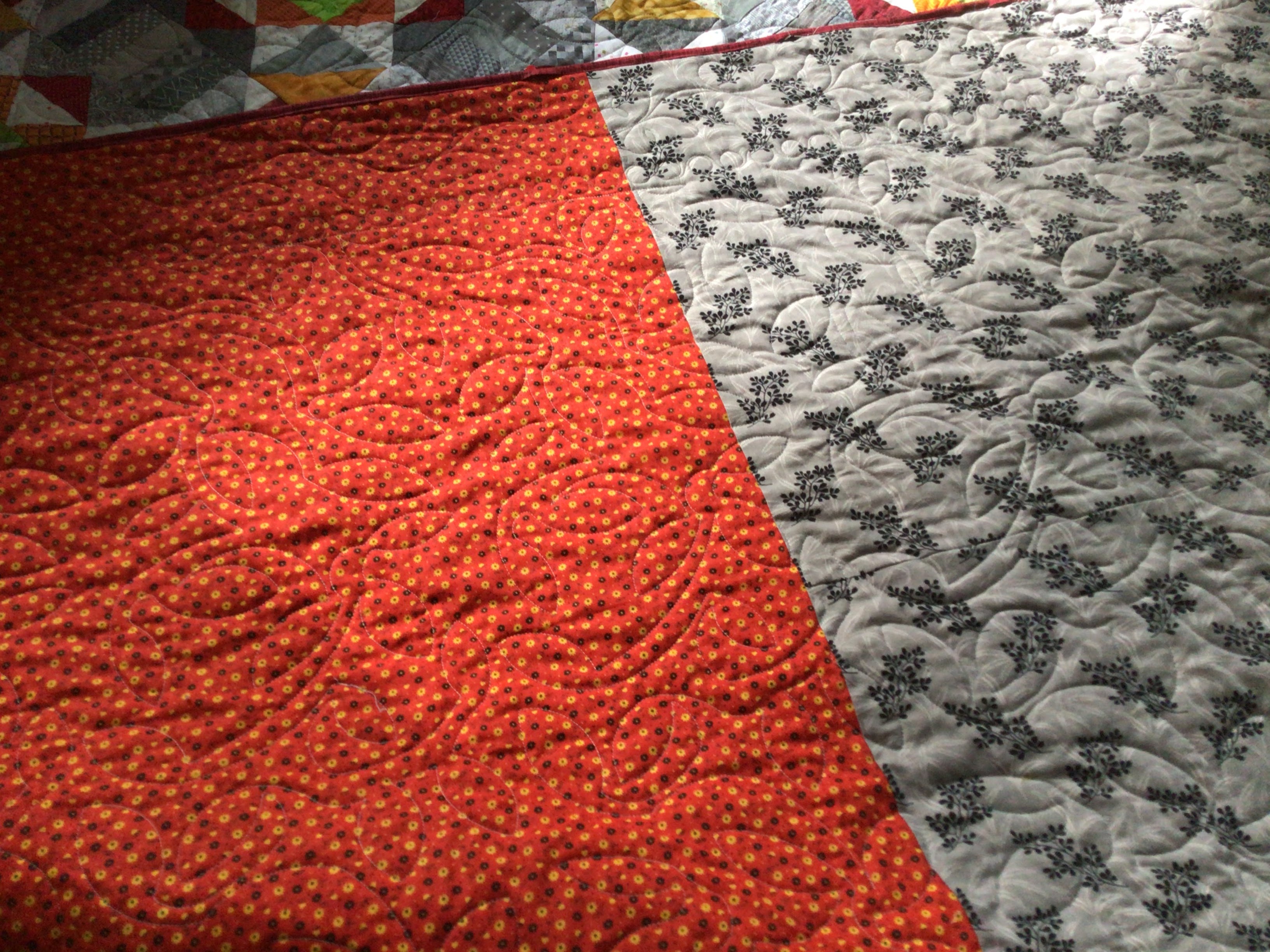
Barb of MB Services did a great job quilting Grassy Creek. I picked it up Monday and bound it this week.  It will be a raffle contribution.  94 x 94 is a big quilt!


I used a vintage print (red) and a rummage sale bargain (9 yards for fifty cents!) for the back.

# # # # # # # #


I achieved the two parts of my declared One Monthly Goal.  Part one was to piece the back for this quilt. I did that and finished the quilt. 


Part two was to assemble the blogs for the comfort quilt I am coordinating. There were many block-makers. I managed to make all the blocks fit. 

# # # # # # # #


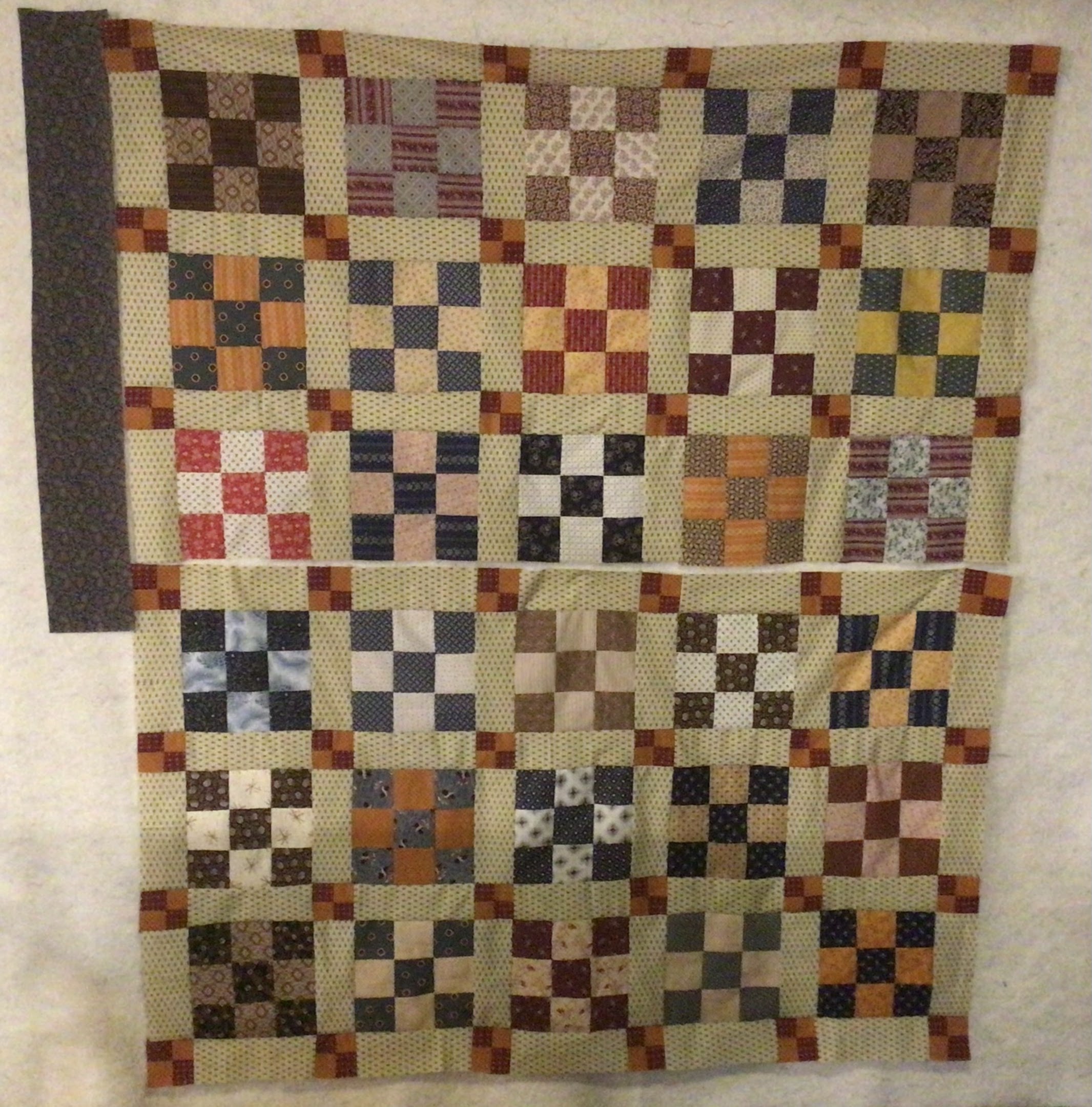
Last fall I worked diligently to bust my 250+-yard CW reproduction stash.  I barely made a dent, as you could guess.  I tossed usable scraps into a box.  This quilt by Etherington and Tesene caught my eye. They used truly little scraps -- their units are 1-1/2". I took their idea and made 2-1/2" units.  

The gold strips and the green inner border are not CW prints but they work well with the CW palette. 


 # # # # # # # #

Just one book this week -- but it was a good one! (My husband read it first and kept saying, "You're going to enjoy this." He was right.) 

Caracaras are western-hemisphere falcons native to South America documented by European explorers (Darwin) and colonists. On the Falkland Islands the striated caracaras are called Johnny rooks. They are curious, intelligent, and sociable to the point of being pests. Jonathan Meiburg describes their present status on the Falklands, further north in Guyana, further inland on the Altiplano, and life in captivity in nature parks in Britain -- all of which he traveled to. He also writes about their evolutionary history with hypotheses about their future. Oh, yes -- he fits in a lot about the Argentinian/British naturalist and writer W. H. Hudson. 

"The researchers who study our planet today live in an age as full of insights and discoveries as the nineteenth century, and it must be maddening to be confronted again and again with the fact that many people simply don't care. Every scientist I'd met seemed to wonder how often they'd have to repeat that there's far more to learn about the world than we already know, how much of it lurks in the guise of the unimportant, and that all it takes to break new ground in the pursuit of knowledge is a desire to do the hard work of seeing. (p. 260).

Meiburg writes wonderfully. Now for a couple of National Geographic features and a PBS Nature about the caracara!

Linking up with One Monthly Goal, Oh Scrap!   Monday Making,  Design Wall Monday

Sunday, January 24, 2021

Weekly Update: making history (with mittens), pink and more pink, Grassy Creek!, and reading


It was beautiful at the beach when I snapped the photo but at 19 degrees I didn't linger!  The clouds have returned and there's snow in the forecast. 

Years ago I read a time management book that likened the results of procrastination to an obstacle that gets bigger around as the procrastination continues - so big that it takes more effort to go around it than it would be to just go over it.  That's how I've been with a non-quilting project this week that involved report-writing and statistics-compiling. I have to check to see that all the numbers add up and proofread the narrative before I send it off to the appropriate committee chairs. I have spent more time agonizing over it than it's taken to do it.  Will I never learn?     

We watched the inauguration on Wednesday with joy.   Wasn't poet Amanda Gorman wonderful?      This article describes the women's stylish coats -- and note the added commentary about the men's coats. <g> 

We saw Bernie Sanders and his mittens -- and so did the rest of the world.   Bernie memes have flooded Facebook.  I've paid most attention to those about libraries and quilting.   We are hopeful with the direction of the new administration. 

# # # # # # #  # #

On Wednesday evening the North Suburban Quilters Guild hosted  Australian quilt maker Jen Kingwell for their monthly program.  The guild boosted their Zoom license to accommodate all the guests, of  whom I was one. (One of 141 attendees.)  Just $10 for a grand quilt show and tell!   


 In the studio:  I made six 8-inch heart blocks for the RFQFA -- the Rotarian Fellowship of Quilters and Fiber Artists. 


Joy, aka the Joyful Quilter, has a Table Scraps sub-challenge for the 2021 Rainbow Scrap Challenge.  I wasn't up to making a table runner (especially in pink, this month's RSC color), so I made two 8" potholders.  


I made a few more pink framed four-patches.  They're 5.5" unfinished.


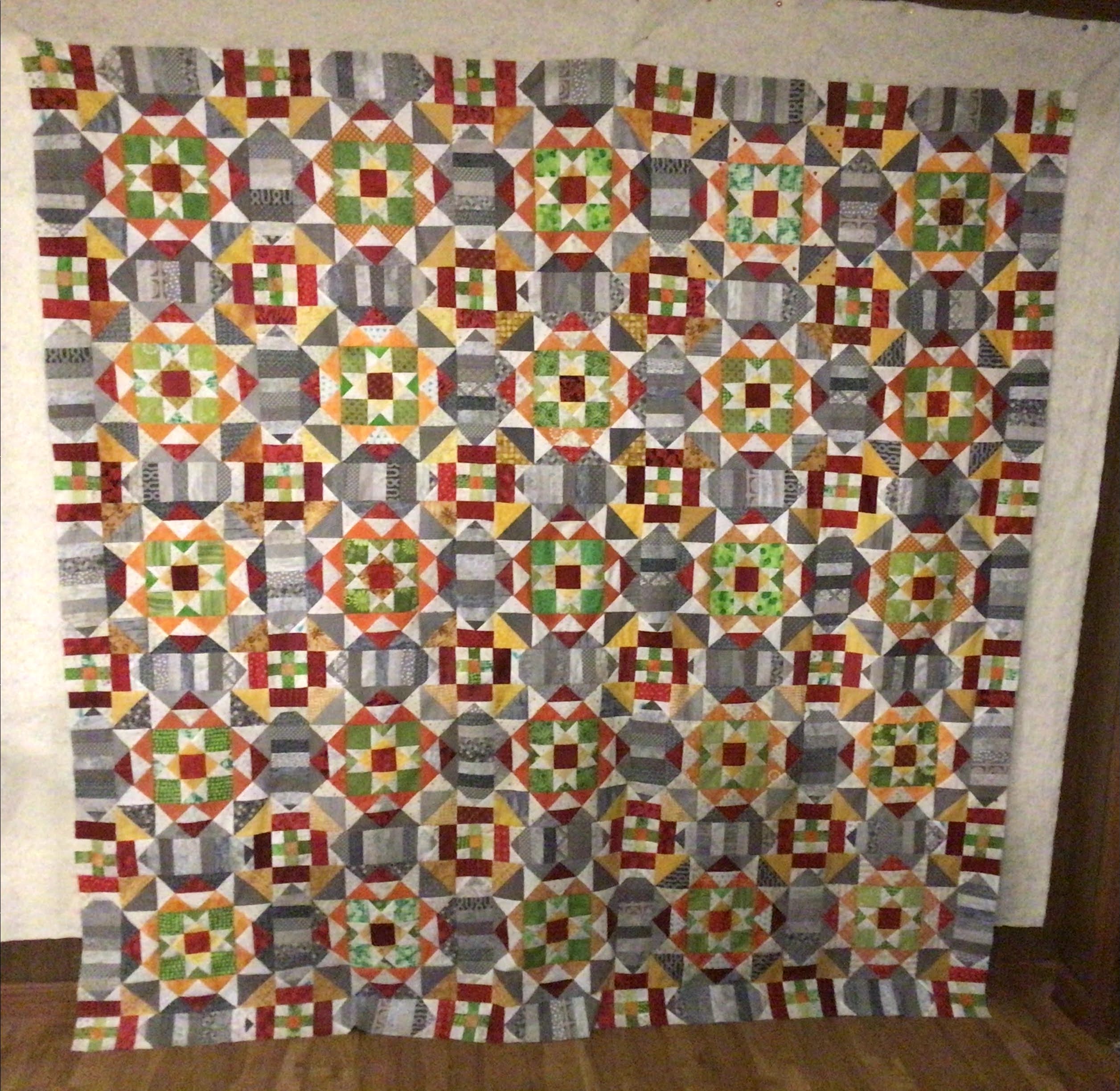
I saved the biggest accomplishment for last.  Grassy Creek is a flimsy!  

And big it is -- 96". Every year I say I'll make just a few blocks. Every year I get caught up in mystery quilt fever and make the whole quilt.  


The border has 28 uphill and 28 downhill blocks.  I miscounted and ended up with 44 going one way and just 12 going the other, so I had to make 16 more of "the other."  


I'll have fun fiddling around with ways to use the leftovers.

# # # # # # # # 


One page in and I was hooked on Monica Wood's splendid memoir about 1963, the year that changed her life forever. No, JFK's assassination was the second event. The first, and more important, happened in April of that year: her father suffered a fatal heart attack on his way to work at the Oxford paper mill in Rumford, Maine. The unexpected, sudden death shattered the universe for Wood, for her mother, and her four siblings. Wood writes from the clearly-remembered perspective of her 9-year-old self: the neighbors who rallied around the family, her uncle (mother's brother)--the priest whose own center was rocked by the death, and details of life in a mill town when things were prosperous and ever  hopeful.

(How did I miss this when it was published in 2012? A friend recommended it after I reviewed Mill Town, Kerri Arsenault's 2020 memoir about the same town.)

Linking up with  Oh Scrap!   Scrap Happy Saturday      Design Wall Monday  Monday Making


Sunday, January 17, 2021

Weekly Update: a flimsy and three-quarters, more scraps, and two books


We revisited Pine Dunes Forest Preserve on Sunday afternoon.  A hiking stick with a carbide tip was a welcome accessory on the packed-snow (sort of melting) trail. 


The framed four-patch batik project is now a flimsy.  In retrospect the borders (made from 2.5" squares) are a little heavy. I'm not sure whether I'll change them (smaller squares? piano keys?)...no rush.


Grassy Creek is three-quarters of a flimsy. All the blocks and the sashing are assembled.  To come:  a different sashing around the perimeter, an inner border, and an outer border. 

I fussed around with color placement--specifically, the gold corner triangles and the gray edge triangles -- but I was able to use a wide range of fabrics in each color so they're pretty evenly distributed.

 It's certainly busy!


The framed four-patches inspired a few pink blocks. I expect I'll make them in other RSC colors. 


The Magpies are making a quilt for our dear Celia's beloved granddaughter.  Each of us got six fat quarters from Celia's stash. We're to make as many Scrappy Trip blocks from them as we can. 


# # # # # # # # #


This week's reading included two 2020 novels that were very compelling.


 Gifty is a brilliant neuroscience graduate student at Stanford whose research involves stimulating the brains of laboratory mice to measure their choice and risk behavior.  She says, "In my work I am trying to ask questions that anticipate our inevitable recklessness and to find a way out but to do that I need to use mice." (p. 226) 
Her own choices/risks come from her upbringing in the urban south, the child of Ghanaian immigrants. She grew up in the shadows: of the Pentecostal faith that her mother enthusiastically embraced, of her father who could not adjust to America and returned to Ghana, and always in the shadow of her adored athletically gifted older brother who died of a drug overdose while still in high school.


Louise Erdrich draws on the true story of her grandfather, a Chippewa on the Turtle Mountain Reservation in North Dakota.  In the early 1950's Congress considered major legislation to remove the tribe from the reservation.   The story is more complex than this grassroots advocacy effort (a decade before Civil Rights activism in the American south and two decades before the American Indian Movement).  The other story threads involve Patrice Paranteau who is determined to better herself and help her family.  She travels to Minneapolis to try to find her sister.  She confronts two men, one native and one white, who think they are in love with her.  There are teachers and townspeople, farmers and factory workers. The characters are memorable.  

# # # # # # # 


P.S.  Look who turns three to the fourth power (3 x 3 x 3 x 3) on Monday!  (When I showed him the photo he said, 'Boy, I'm an old guy.")


Monday, December 28, 2020

Weekly update: hiking, feasting, quilting, reading

 Thursday evening:   the first Christmas Eve service I've attended with my sewing machine.  That was so we could watch the Lessons and Carols on our church's YouTube channel.   We fervently hope that this was a one-and-only and that next year we can worship in person.  We dimmed the lights and lit candles for  Silent Night.  


Christmas dinner: roast beef, acorn squash, braised parsnips. Pear/spinach salad.  Cranberry-pumpkin upside down cake.  The vintage tablecloth just covered the table. (The table is mid-19th century and not a standard size.)   And when was the last time you used a pickle fork?  LOL. 


We went to Lyons Woods Saturday afternoon.  Ornaments were hung -- randomly -- on trees along the trail.  Once I caught on I kept walking to see if I could find more.  Two women I passed said they'd counted more than 40.  


Though we are in a "snow drought" it's still gotten cold.  There was ice in the tree roots at Illinois Beach on Sunday.   Shoreline erosion toppled these trees within the past two years.  

Lower center:  There is a bike trail (finely-packed gravel) under about a foot of sand.


# # # # # # # # # # # 

In the studio:   Nine-Patch Churn Dash is a flimsy.   I used "All in a Row" by Kim Diehl as the starting point.  


The next CWRSRP (Civil War Repro Stash Reduction Project) is nearly a flimsy.  

The design idea is from a quilt called Blue and Gray by Etherington/Tesene.  


Here are the 9-patches, flying geese, and red units for Clue 5 of Grassy Creek.  

When I began the mystery the fabrics were neatly arranges in the box.  Five weeks in, not so much. 


It's time to post December OMG finishes.   I said I would piece the quilt code-named Welcome Home.  (This is all I will show because it's a surprise.)  It is on the long-armer's schedule for the end of January.  

The photo shows the flimsy and the backing (a black/white thrift-shop sheet).  

# # # # # # # # # # 
Kerri Arsenault's memoir Mill Town: Reckoning With What Remains has been named to several "best of 2020" lists.  The accolades are well-deserved.  
Arsenault lovingly, critically, fearlessly, and lyrically describes the past and present of Rumford and Mexico, Maine, the community where she grew up. Her father, grandfather, and great-grandfather all worked at the paper mill that for 150 years has produced cardboard and coated stock. The bleaching process uses chlorine; its byproduct is cancer-causing dioxin -- and cancer is the primary cause of death many, many millworkers and members of their families. Arsenault probes to find documentation and to tries to get corporate admission of malfeasance. She describes growing up in the town where the smell of the mill meant the smell of money. She explores her family's journey from 17th century France to P.E.I. to early 20th century Maine. She acknowledges the challenge to Rumford/Mexico: how do company towns endure in an era of leveraged buyouts, takeovers, and offshore production? (She details how Rumford -- desperate to diversify revenue -- sold significant access to its water supply to Nestle/Poland Spring.)
An important book, all the better for Arsenault's extraordinarily fine writing.


Monday, December 21, 2020

Weekly update: the solstice, some sewing, some reading


The first day of winter!   The sun was behind the clouds at 7:13 a.m.   The sandy bluff where I usually take sunrise pictures, such as the one six months ago for the summer solstice, is closed to vehicles for the season.  Thus this photo overlooks the empty boat slips at North Point Marina. 

I took the photo on the right on my Sunday afternoon walk.  The ravine is at the end of our street. The creek flows to the park adjacent to the marina. 


In the studio:  

Grassy Creek, clue 4. 


I've made 17 out of the projected 20 9P churn dash blocks.  I hope to get these to the flimsy stage this week. 


 I got the ARC (advance reader copy) of Kendra Atleework's memoir at ALA Midwinter; it was published in June.    It's a fierce and loving tribute to place and to family.   The place is Bishop, California, in the Sierras -- the water source for Los Angeles.  The family are her father, her mother (who died when Kendra was 16), and her sister and brother. Atleework went to college in Los Angeles and to graduate school in Minnesota (where the green-ness was astounding and disconcerting) -- and finally returned to Bishop. 


Linking up  with:  Oh Scrap!  Monday Making  Design Wall Monday  

Sunday, December 13, 2020

Weekly update: hikes, waves, some quilt making -- and this week's reading

 We still have a few forest preserves to visit!  On Thursday we went to Nippersink .  


The gravity-defying tree has another outstretched limb pointing straight ahead.


A front came through and it rained Friday afternoon and all day Saturday.  The weather forecast said waves would be high on the lake and I went to see for myself.  

In the upper photo: the seawall (on the left) used to be at the water's edge. The round thing in the middle is a concrete storm drain that used to be covered by sand and gravel and a good 10' from the water.  Erosion is so severe that now it's in the water. 

Just two years ago the sand that you see was at least six feet above and twenty feet behind the water line.

# # # # # # # # # #


The Zion Woman's Club's holiday service project was a "reverse advent calendar" food collection -- 24 food items to represent December 1 to 24.  Those who participated took selfies at home with their contributions. On Friday we met at the two food pantries in our community to deliver the bounty. (We were close for the photos but for just a couple of minutes, and we all wore masks.)   Abiding Love Food Pantry has gone from serving 200 people a week in 2019 to more than 325 a week in 2020.  Giving Point Food Pantry distributed 500K lbs of food in 2019 and will exceed 1M lbs in 2020. 

# # # # # # # #


In the studio:  I finished Code Name Welcome Home.  It's a surprise so I will only give you a sneak peek.  A set of black-on-white cotton sheets [actually: twin flat and fitted and queen flat -- all the same print] will be ideal for the backing.  Because it is 84 x 84 and has big pieces I will have it professionally quilted.  I'm on the long-armer's schedule for the end of January.    [The flimsy used 8-1/4 yards.]


I have a bag of left over  black and gray cutaway triangles to play with.  I am thinking about pairing them with RSC colors in 2021.  


Here's Clue 3 for the Grassy Creek mystery.  


This is the next installment of the CWRSRP (Civil War Reproduction Stash Reduction Project).  The blocks are 10".  I'm aiming for 20 checkerboards and 12 baskets.   As I look at the photo I wonder if I should make all the checkerboards dark/medium (not dark/light) so the baskets will stand out. 


# # # # # # # # #

I followed last week's book about the Florida land boom with another on that topic.  As its title clearly conveys, this one concentrates on the development of Palm Beach.   It began with Henry Flagler and ends with Donald Trump -- with a lot in between about the "industrial wealthy" (as opposed to old money wealthy) who built mansions and established exclusive clubs on the narrow island between the Atlantic and Lake Worth.    I learned a lot about Marjorie Merriweather Post.  She was the wealthiest woman in America and could well afford to build the fabulous Mar-a-Lago.     


I finished Julie Kibler's novel in a day and a half.  The Home was a real place in Arlington, Texas, in the early 20th century that pledged, "we will not give away your child."  That was counter to the norm of putting illegitimate babies up for adoption.  Kibler bases the early characters on women who lived at the home. That story alternates with the contemporary story of Cate, a librarian and archivist at the university that is on the land where the Home had been. When a new student assistant comes to work for Cate she has to come to grips with issues from her past.  It's a good story!


Linking up with Oh Scrap!     Monday Making

 Design Wall Monday

P.S.  The parking lot guardian on duty at Nippersink.   


P.S. 2   Christmas Medley made $360 for the AAUW Greatest Needs Fund.  This post explains the genesis of the quilt.