Showing posts with label Books of the Week. Show all posts

Friday, February 17, 2023

BOTW: what a family!

Marie Benedict's latest novel again tells the story of women whose names we may know but whose lives we don't know much about.

Aristocratic, glamorous, on the verge of going broke -- the Mitford family could have been dreamed up by a satirical novelist except that they were very real. (And, actually, eldest daughter Nancy did thinly-disguise her siblings in two of her novels.) Diana, the second daughter, divorced her husband (heir to Guinness brewing) to marry Oswald Mosely, head of the British Union of Fascists. Unity, the third daughter, was enamored by Adolf Hitler and became part of his inner circle. (Brother Tom and sisters Pamela, Jessica, and Deborah led somewhat less sensational lives. The senior Mitfords, called Muv and Favre by their children, vacillated between genteel almost-poverty, hatred of the "Huns," and admiration for Moseley's BUF.)

Marie Benedict focuses on Nancy, Diana, and Unity.  Nancy's first-person account shows her trying unsuccessfully to talk sense into Diana, Unity, Muv, and Favre, dealing with her ineffectual alcoholic husband and her childlessness, and trying to make a living with her writing. Diana and Unity's stories are told in the third person. Diana uses Unity's connection to Hitler to strengthen her marriage to Moseley. Unity fancies herself a bridge between Germany and Great Britain, not realizing that Hitler is exploiting her just as he exploits everyone in his quest to conquer the world.

Nancy's story concludes: "How personal is the political in the end, I think. It turns each one of us into the authors of our own histories, we become patriots and heroes and, where necessary, spies and traitors. Which one of these, I wonder, am I?" (p.395)


Thursday, February 9, 2023

BOTW: two graphic novels

Graphic novels are not a format that greatly appeals to me.  That's a personal preference. I know they are very diverse, from traditional comic books to Japanese manga to original works of fiction and nonfiction, with titles appropriate for (and to appeal to) kids, teens, and adults.  They're all represented in my public library's collection.  (Said library being my former place of work.)


One of the reading prompts for The Page Turner 2023 is "a graphic novel."   I welcomed the opportunity to expand my reading horizons and chose Art Spiegelman's Maus (v. 1 and v. 2).

I've known about Spiegelman's powerful book for decades. It has been recently been challenged in a number of school districts "for violence, nudity, and profanity." I think it is a splendid story. Vladek Spiegelman is a man scarred emotionally and physically by the unimaginable horror of his experience in the Holocaust, forever questioning why and how he survived when his family and friends did not. He was clever and scheming, loyal and loving. His son Art uses his talent as an illustrator and writer to try to make sense of his father's tortured and complex story. Art's love shines through his exasperation with his father. The Holocaust should never be regarded as just a historical episode. It affected millions of people and the ripples from that are with us today.

As for the challenges: no, it is not a book for small children. But high school students can handle it, and certainly adults can, too.

# # # # #

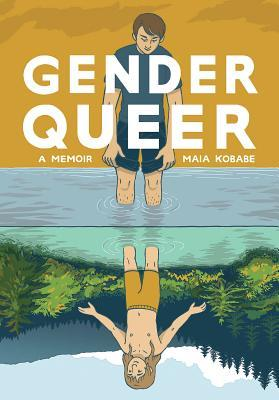
Maia Kobabe's memoir Gender Queer has also been challenged in schools.  I read it last fall to see what the fuss was about.  I thought it was great.  Maia comes to terms with er [that's a pronoun preference] identity on many levels -- sexual, intellectual, professional, familial--and documents that journey in word and picture.  Once again, it is not a book for small children.  For teens with questions, or teens with friends/relatives with questions, or for adults with questions,  this story of one person's experience can illuminate the way for others.

(And I think Kobabe's parents are exemplars of understanding and support..)    

Thursday, February 2, 2023

BOTW: palace intrigue


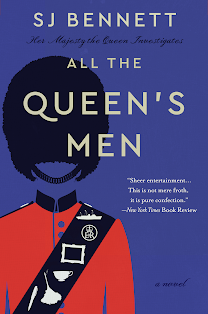
In 2016 a not-well-liked housekeeper at Buckingham Palace is found dead at the edge of the indoor swimming pool.  The  news makes its way to the Queen.   She is 90 and slowing down somewhat physically but not mentally.  She encourages an investigation that involves her Assistant Personal Secretary Rozie Ochoda.  The plot thickens when they learn that the dead woman began her career as an art historian inventorying the Palace art collection.  Why was she demoted?   The investigation is literally winding when Rozie goes down to the tunnels that connect the palace buildings.  The queen floats above it all, her tact and diplomacy ensuring that what needs to be uncovered is disclosed and what needs to be kept secret remains that way.

I very much enjoyed  The Windsor Knot, Bennett's first mystery featuring the Queen and her  Rozie.  This second installment did not disappoint!

The third in the series, Murder Most Royal, has been published in the UK.  U.S. release date is September12, per Amazon. 

And coincidentally we are watching Season 5 of The Crown on Netflix with Imelda Staunton playing Elizabeth.

Tuesday, January 24, 2023

BOTW: all that glitters


In the early 20th century the Franco-American Pelletier family arrived in Colorado to join their father/husband at the Moonstone marble quarry.  Daughter Sylvie tells the story of the terrible conditions for the quarrymens' families -- unheated, unplumbed shacks, far from town.  When she finishes school she gets a job as a reporter for the scrappy labor-friendly local newspaper.  The next summer she is hired as the secretary for the quarry-owner's (third) wife.  Sylvie sees first-hand the profligate luxury of the robber barons and is determined to work for justice for the working class.  Her life is complicated by the attentions of Jace Padgett, the quarry-owner's son, and of George Lonahan, an organizer for the United Mine Workers.   Sylvie's choice begins as a disaster but subsequent events turn out for the better.

"We cannot help how the past is knitted into the calcium of [our] bones, pressed and hardened as coal is under the great pressure of living, frenzy, and worry," she writes in 1934 (p.435).  But when her young adult daughter brushes off a story from those formative years, "In a snap like that I saw how history is lost....For you, the past is alive in yourself as breath. To...the young, it's a story, no more real in life than a painting. They're in their own story." (p.444)

The story invited comparison to Jess Walter's The Cold Millions (review here)  


Tuesday, January 17, 2023

BOTW: saints and troublemakers

 BOTW = Books of the Week -- what I've been reading lately.


"I sing a song of the saints of God, patient and brave and true....one was a doctor, and one was a queen, and one was a shepherdess on the green....and I mean to be one, too,"  goes the Sunday school hymn

Daneen Akers tells the stories of 37 of these saints in short biographies. Some are well-known (Florence Nightingale, Harriet Tubman, Francis of Assisi, Mr. Rogers). Some are lesser-known (suffragist Alice Paul, preacher Anne Hutchinson, civil rights leader Bayard Rustin, poet Mary Oliver). Others were new to me --and what a wonderful group! Imams, rabbis, and pastors, making trouble mostly in the U.S. but in other countries as well. Cis, trans, straight, gay. All of them speak truth to power as they seek in their way to "work to heal our present world, making it a just, safe, and compassionate home for everyone." 

Each biography includes a follow-up question asking readers how they might exemplify that saint's mission. "What are some ways you can help others to be free? Have you ever had to do something that felt scary in order to be true to yourself? What does it mean to you to 'love without exception'?"   

Inspiration and food for thought for kids (10 and up) and adults.  

# # # # #

And on the topic of holy troublemakers, "How do you solve a problem like Maria?" leads to The Sound of Music which leads to Julie Andrews which leads to the next book. 


"Let's start at the very beginning/that's a very good place to start. When you read you begin with A, B, C / when you sing you begin with Do, Re, Mi." We automatically hear Julie Andrews singing that famous song in The Sound of Music. And who better to explain just how musical notation began?

In this charming picture book Andrews and her daughter Emma Walton Hamilton tell the story about the 11th century Italian Benedictine monk Guido d'Arezzo. "Guidonian Hand" is the term for the notation system he codified.

The story is enhanced with essays about the contemporary song, written by Rogers and Hammerstein; a glossary; a description of life in a medieval monastery; and historical notes.

Children's books can provide just the right amount of information on a topic, as The First Notes proves.  

Monday, January 9, 2023

BOTW: a five-star recommendation


Is January 9 too soon to declare a favorite book of the year? Joanna Quinn's sweeping novel will certainly be high on my list for 2023.

Christabel Seagrave, her stepsister Flossie, and her cousin Digby (who is Flossie's stepbrother) grow up at Chilcombe, their family's crumbling manor in the Dorset countryside. The adults (parents, a stepmother, and an uncle/father/stepfather in one, as well as a couple of permanent houseguests) leave them largely to their own devices though the servants (cook, butler, maid, and governess) look out for them.   

 In 1928 when Christabel is 12 a whale washes up on the shore. She claims it and uses the bones to create a theatre on the lawn. Over a decade she stages many plays (mostly Shakespeare) with Flossie, Digby, the adults, and the servants among the repertory company.

When World War II begins Digby enlists in the Army and is sent to Africa. Christabel joins the Special Operations Executive, the secretive intelligence division on the ground in Occupied France. Flossie joins the Land Army and keeps Chilcombe going as a working farm.

Who can Christabel trust in those dangerous days of 1944 when a misspoken word or even a glance can break the most carefully-constructed cover? In the end it is those whom she has known the longest and loved the most. The Seagrave siblings are forever bound to one another.

P.S. Kudos to publisher Knopf for retaining British spelling (theatre, colour, favourite, etc.)

P.S. 2 p. 125: "Their most-loved books have been read so many times, they only have to look at the covers to know how it feels to be enclosed within them. But the worlds contained within the books do not remain between the covers. They seep out and overlay the geography of their lives."

Sunday, October 2, 2022

BOTW: October book club selections

This is the October selection for my AAUW branch book group. 

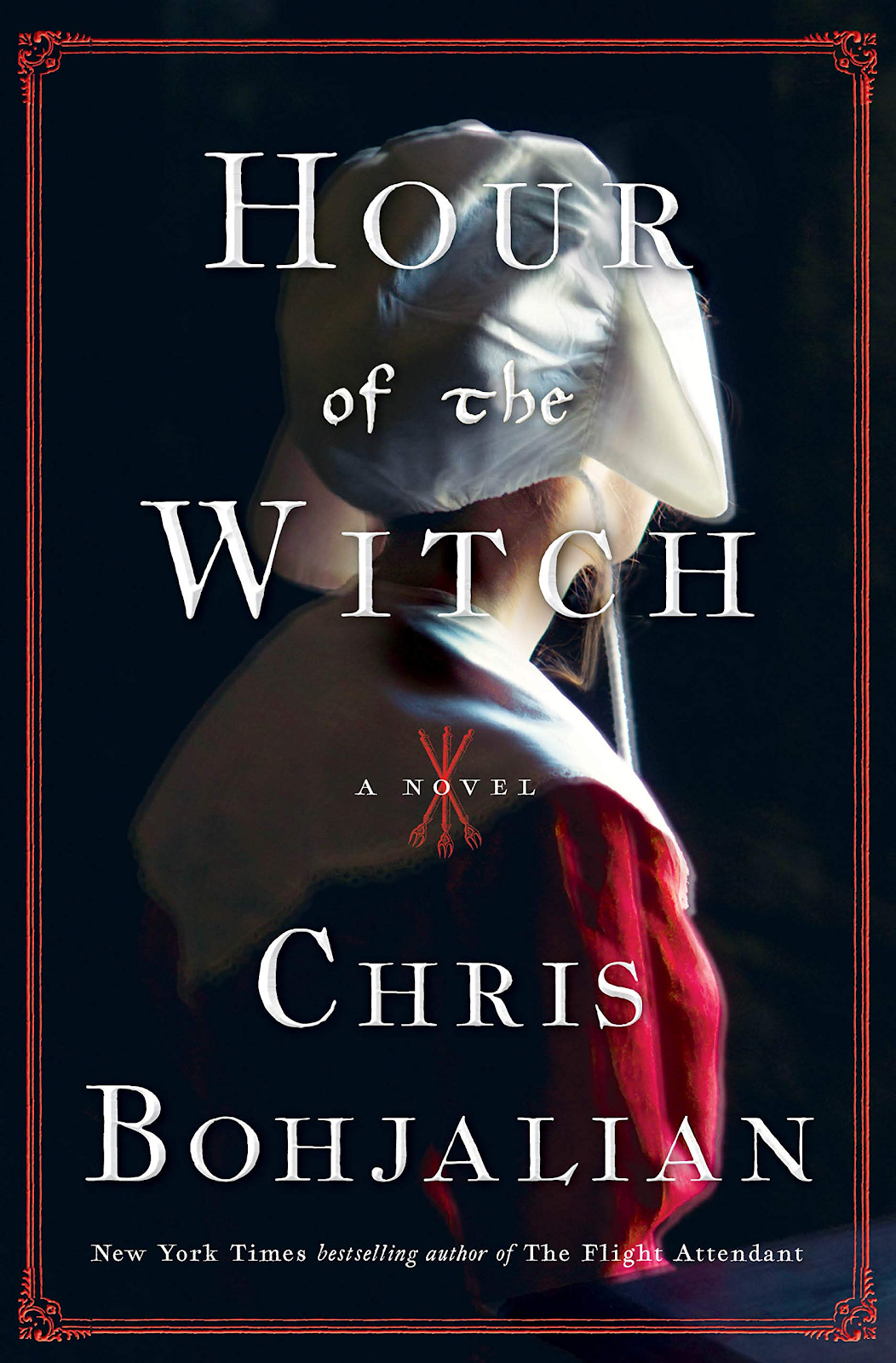
In Puritan-ruled Boston in the 1660s a wife was subject to her husband. If the marriage was troubled it was likely her fault and the cause was often attributed to a lack of Godliness. In public the miller Thomas Deerfield was a prosperous, Godly businessman, though somewhat overfond of drinking at the tavern. In private he physically and emotionally abused his much-younger second wife Mary. Some bruises she could cover and explain away as clumsiness. Then he jammed a fork into the back of her hand and ordered her to tell people she had bruised it on the spout of the teakettle. Mary resolved to leave him and petitioned the court for a divorce, and action positively unheard-of for the times.   Not only did she endure that trial but she was also brought before the magistrates on accusation of witchcraft and consorting with the Devil. 

Mary Deerfield was smart and determined. She advocated for herself in front of the authorities. She was strategic in planning her own defense. The suspenseful tale comes to a very unexpected resolution.

Chris Bohjalian is a master at weaving a tale out of a subject we are aware of but likely haven't thought much about. There is much to think about and discuss.

# # # # #

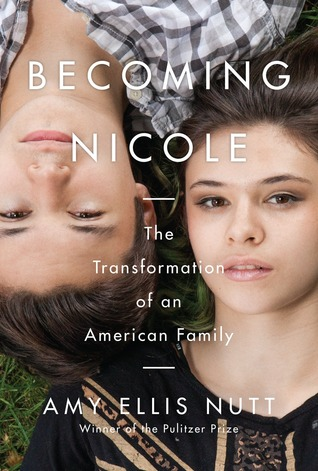
Becoming Nicole is the October selection for the P.E.O. online book group.  
 
In 1997 Kathy and Wayne Maines adopted identical twin infants whom they named Jonas and Wyatt.   At a very young age (pre-kindergarten) Wyatt showed a marked preference for girls' clothing, toys, and activities.   Wyatt insisted he was female.   It took adjustment for everyone, but Kathy and Wayne put their child's well-being first.  For the most part school personnel were cooperative, but one man in town harassed Wyatt (now Nicole) and the family and forced a 2007 court case for birth-gender restrooms.   At age 18 Nicole had gender-affirming surgery.  

I admire the Maines family and their support for their transgender daughter as they dealt with bigotry and ignorance. And they triumphed!  

Sunday, September 18, 2022

BOTW: two beloved villages


A while back I decided it was time to revisit Port William, Kentucky, by reading or rereading the several volumes of Wendell Berry's stories I acquired many years ago.*  It was part of a resolve to read what was already on my shelves rather than adding more.

Almost three years after that grand declaration I've finally finished A Place On Earth, Berry's 1993 revision of the 1967 edition.  

 A Place on Earth is set in the spring of 1945, a pivotal time for the larger world and for the small Kentucky community.  Virgil Feltner is missing in action in Europe and that not-knowing affects every moment of Mat Feltner's days. But life goes on for Mat and the Port William Fellowship -- Uncle Jack Beechum, Burley Coulter, Jayber Crow, and a host of others.    Tragedy, comedy, hard decisions, new life, and hope -- all told with Wendell Berry's characteristic grace and style.  

P.S. I went to Alibris and ordered all of the Port William books I didn't have. So the bookshelves get even fuller.

*I read Hannah Coulter in 2019 and The Wild Birds in April of this year .  A Place on Earth precedes both of these.  Episodes in A Place on Earth are more fully developed in the later books. 

# # # # # #


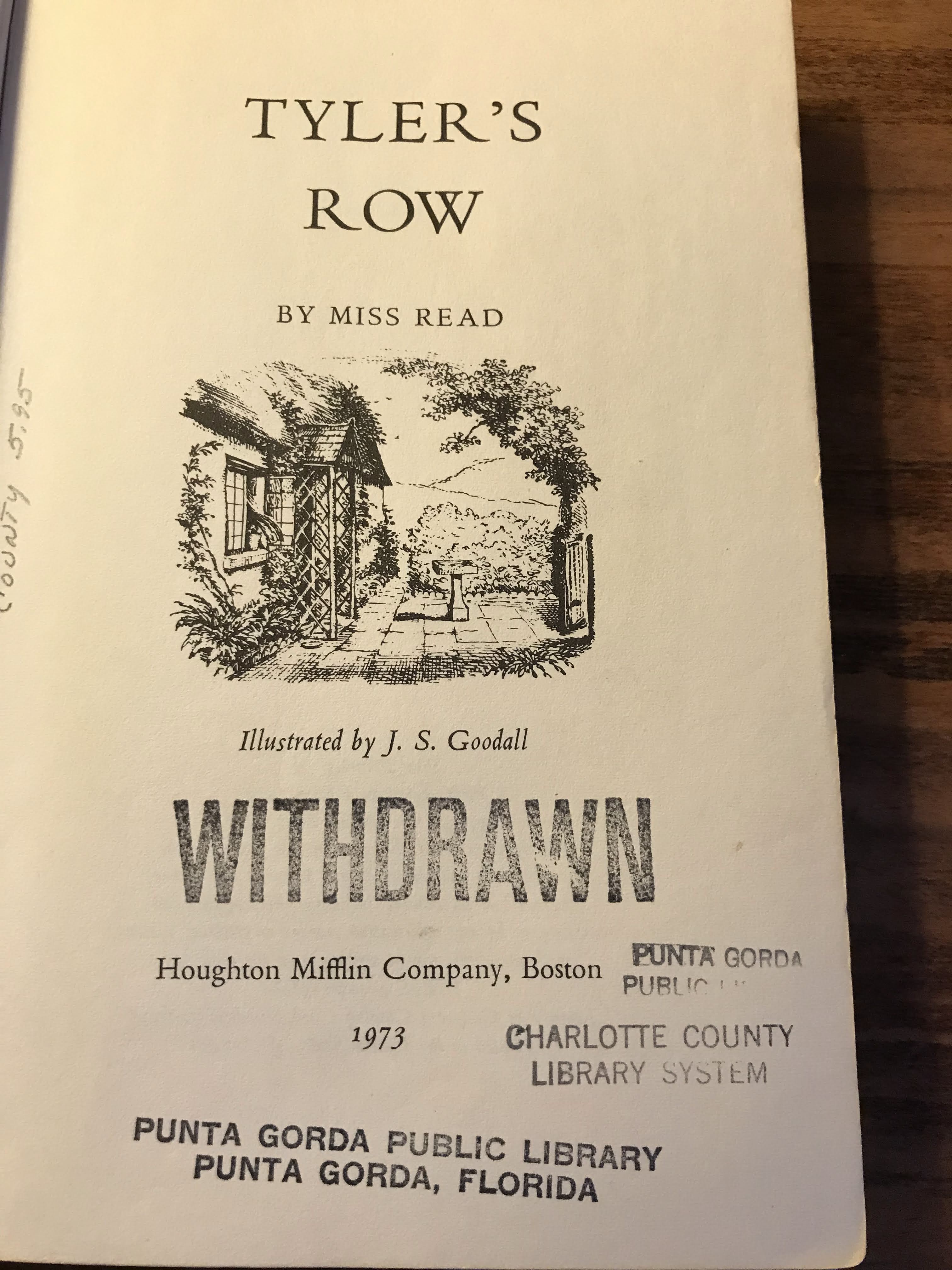
 I came upon this well-used ex-library copy of Tyler's Row at the church rummage sale. Just twenty-five cents. How could I resist? It was as charming as when I first read it years and years ago.  

Peter and Diana Hale are looking for a country retreat and see great potential in the eighteenth-century Tyler's Row, a three-dwelling row house in the village of Fairacre.  The elderly tenants in the two end units have been at odds for years and Peter and Diana must put up with their feuding while they remodel the center unit for themselves.   Meanwhile Miss Read, the omniscient narrator, deals with small and large events at her school and in the village. 


You can read more about Dora Jessie Saint (1913-2012), aka Miss Read, here.   Her books depict a gentler time (even 1972, when Tyler's Row was published), filtered through a lens of nostalgia.  

(How did a book from Punta Gorda get to Zion?)


Left:  Miss Read and her housekeeper have a discussion.

Even before I opened Tyler's Row I recalled  J. S. Goodall illustrations.


Thursday, September 1, 2022

BOTW: catching up on August

This Books of the Week post should more appropriately be Books of the Month.  I will get back to more frequent book reviews in September.  

It's been a long time since the last Merry Folger mystery and this new entry in the series is most welcome.   The setting is current: November, 2021, when Nantucket brings back its traditional Winter Stroll to usher in the holidays -- with Covid masks on. Merry, now police chief (after her father) deals with two murders. One is a woman photographer living in a ramshackle cottage owned by her long-ex-husband. The woman recently reconnected with her now mid-20's son (whom the ex raised). The other is a lecherous old Hollywood talent agent traveling in the entourage of a film crew that includes an over-the-hill leading man, an unconfident female star, and the talent agent's wife (who is the director). Are the murders connected? Merry and her officers are determined to find out!


This was the perfect book to keep me occupied during a trip that involved long airline flights. I understand why everyone has praised it. It's a truly wonderful story!

In the aftermath of the Bolshevik Revolution Count Alexander Ilych Rostov is sentenced to lifetime house arrest and confined to quarters at the Metropol Hotel in the center of Moscow. He was brought up to be the consummate gentleman, elegant, sophisticated, but always understated. He made the best of a terrible situation from his quarters in the hotel attic (where servants once lived) to actually getting a job as the headwaiter in the hotel dining room (using his impeccable ability to know who to sit in proximity to whom, and his knowledge of fine cuisine). He befriended a young girl (daughter of a Bolshevik party leader) and years later he became guardian to her own daughter. The decades roll on, the Soviet Union becomes a world power, and the Count sees it all from the Metropol.


I was put off this book because it had a science fiction sticker. SciFi is not a genre I particularly enjoy.  It's the September selection for our AAUW book group so I had to check it out. Once I got into it I kept going!

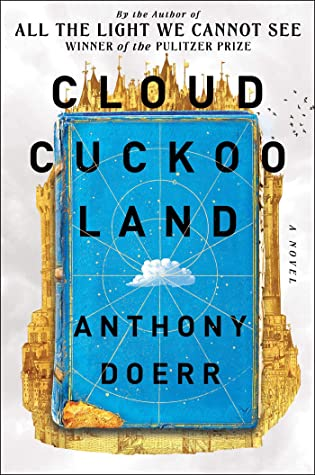
"Stranger, whoever you are, open this to learn what will amaze you." This sentence from an ancient comical (parody?) is one of the threads that links the five storylines in this adventurous novel.

It took a while for me to get into the rhythm of the shifting points of view from the Diogenes story to Constantinopole/Greece in the fifteenth century, the two Idaho storylines (the old man Zeno and the boy Seymour) from 1950 to 2020, and on into the future with Konstance hurtling through space to a new planet.

Words and stories have power that transcend centuries and connect generations.


Not one but two unreliable narrators -- the fictional Freddie who herself was a creation of the fictional Hannah. It was hard to figure out what was happening to whom. No one was particularly likeable.


Sunday, August 7, 2022

BOTW: two for fall

 Two more ARCs (advance reading copies) from the ALA Annual Conference in June. These will be published in October.

The Wilfs have lived on Division Street in suburban Avalon since the late 1960's.   Ben is a family physician, Mimi is a community volunteer. Sarah and Theo are typical suburban teens. On a summer night in 1985 their universe shifts when Sarah and Theo Wilf cause a deadly car accident. They survive but they never forget. Nor does their Ben whose effort to save the victim is unsuccessful. 

Fourteen years later, on the eve of the new century, Ben again is at the scene of a medical emergency. Alice Shenkman, the across-the-street neighbor, goes into labor. Ben gets there before the EMTs and successfully delivers Waldo Shenkman. Waldo has a tough childhood as a social misfit obsessed with astronomy, completely misunderstood by his hard-driving business exec father. Waldo finds a friend in Ben and, as Ben was present at Waldo's birth, Waldo is in turn present at Mimi's death.

The story skips adroitly from decade to decade and back again.  [Including 2020: pandemic (see Delphi, below).]  The younger generation find their places in the firmament -- Sarah as a Hollywood producer, Theo as a renowned chef, and Waldo as an astrophysicist. A wise, compassionate, and thoroughly absorbing story.


The never-named narrator is a British academic with a Classics specialty. She views her personal pandemic experience through the lens of prophesy in the tradition of the Oracle of Delphi. Each short chapter refers to a different divination -- tea leaves, entrails, animal behaviour, guttural sounds. Her experiences are so typical of families trying to adjust to pandemic-caused upheaval. She teaches on Zoom. Her husband works on Zoom. Their ten-year-old son doesn't adapt to at-home onscreen learning. She cannot easily go to visit her elderly mother. There are shortages of all kinds of products as well as a shortage of patience. And in the end, a faint glimmer of the bottom of Pandora's box: hope.

I've observed before that contemporary literature has a new demarcation: set before or during the pandemic. (We can look forward to those that are set firmly after. Soon?)  

Wednesday, August 3, 2022

BOTW: the book of the summer


Every summer deserves a book like this. It is a deliciously long 576 pages. Do I read fast to find out what happens, or do I slow down to savor every scene, every utterance, to catch every clue? The setting is achingly beautiful. The characters, primary and secondary, are memorable.

Agnes Lee and Polly Wister have known one another since birth. Their great-grandfathers, Philadelphia Quakers, built the rambling shingle "cottages" at Fellowship Point on the Maine coast (near Sorrento, I figured out). They have spent every summer of their lives on the Point. "They knew each other so well that their speech was as vertical in nature as a good poem." (p. 81).  Agnes became a famous author of best-selling children's books featuring an intrepid girl adventurer named Nan. Polly married a college professor, had four children, and poured all her energy into her family.

In 2000 the women are 80. Agnes has been diagnosed with cancer. Polly's husband dies. There is talk among the other Fellowship Point residents and heirs about selling out to developers. And Agnes gets a new editor, an ambitious young woman who wants Agnes to write her autobiography. Secrets hidden for decades are revealed. There are misunderstandings and fallings-out. But in the end true, lifelong friendship prevails.

Every summer deserves a book like this, but not every summer gets one. We are fortunate that 2022 is one of those years.

Sunday, July 24, 2022

BOTW: mystery and history with recipes

 BOTW = Books of the Week. It's the new name for my weekly reading roundup.  


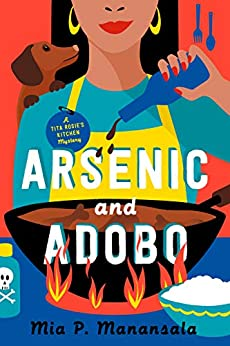
Mia Manansala's debut is a fast-paced cozy mystery featuring a Filipina-American protagonist and her extended family. When Lila's ex-boyfriend drops dead during lunch at her grandmother's restaurant Lila is considered a prime suspect. She enlists her friends to help her find the real culprit. Assumptions are made mistakenly, conclusions are leaped to, and there is a lot of food (Filipino and otherwise).

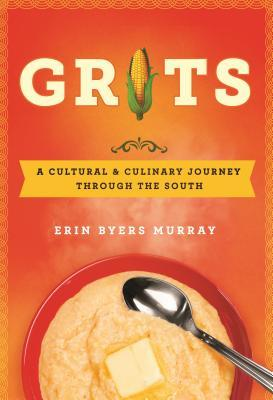
One of my favorite genres, narrative nonfiction, combines with one of my favorite subjects, American regional foodways, in a well-researched but never dull account of ground corn, better known as grits. Author Erin Byers Murray posits that a big reason that many people say they hate grits is that all they've known are gummy, pasty, mass-produced instant variety that cook up fast but are processed to the point of tastelessness. Murray travels throughout the south to meet people who are growing heritage corn and those who are milling it to make the most of the flavor. She writes about the inventors of milling equipment and the people who are keeping century-old machines going. She talks to chefs who develop new recipes and who tweak classics like shrimp and grits. Recipes are included. I intend to check out the specialty mills she mentions and place an order.      


Sunday, July 17, 2022

BOTW: mysterious teens, now and then


Private investigator V. I Warshawski -- better-known as Vic -- is, as usual, supposed to be working for her paying customers when she gets caught up in a complicated series of coincidences. While out running she hears a cry for help and discovers a teenaged girl wedged in the rocks of the breakwater along Lake Michigan.  The girl is taken to the nearest hospital where she is treated -- and from which she disappears.  Finding the girl entangles Vic in a web of intrigue. Vic can never leave her south side neighborhood behind as this new case proves.  It involves a synagogue in Rogers Park, a crumbling mansion on Goose Island, and a nursing home scam on the North Shore.  Chicagoans (and former Chicagoans) will enjoy the local references and all readers root for Vic's strong sense of justice.  

P.S. The setting is current -- that is, 2021, with Covid as a part of everyday life.  It will be interesting to see how other novelists will incorporate this new normal, whether in series or stand-alone.

# # # # #

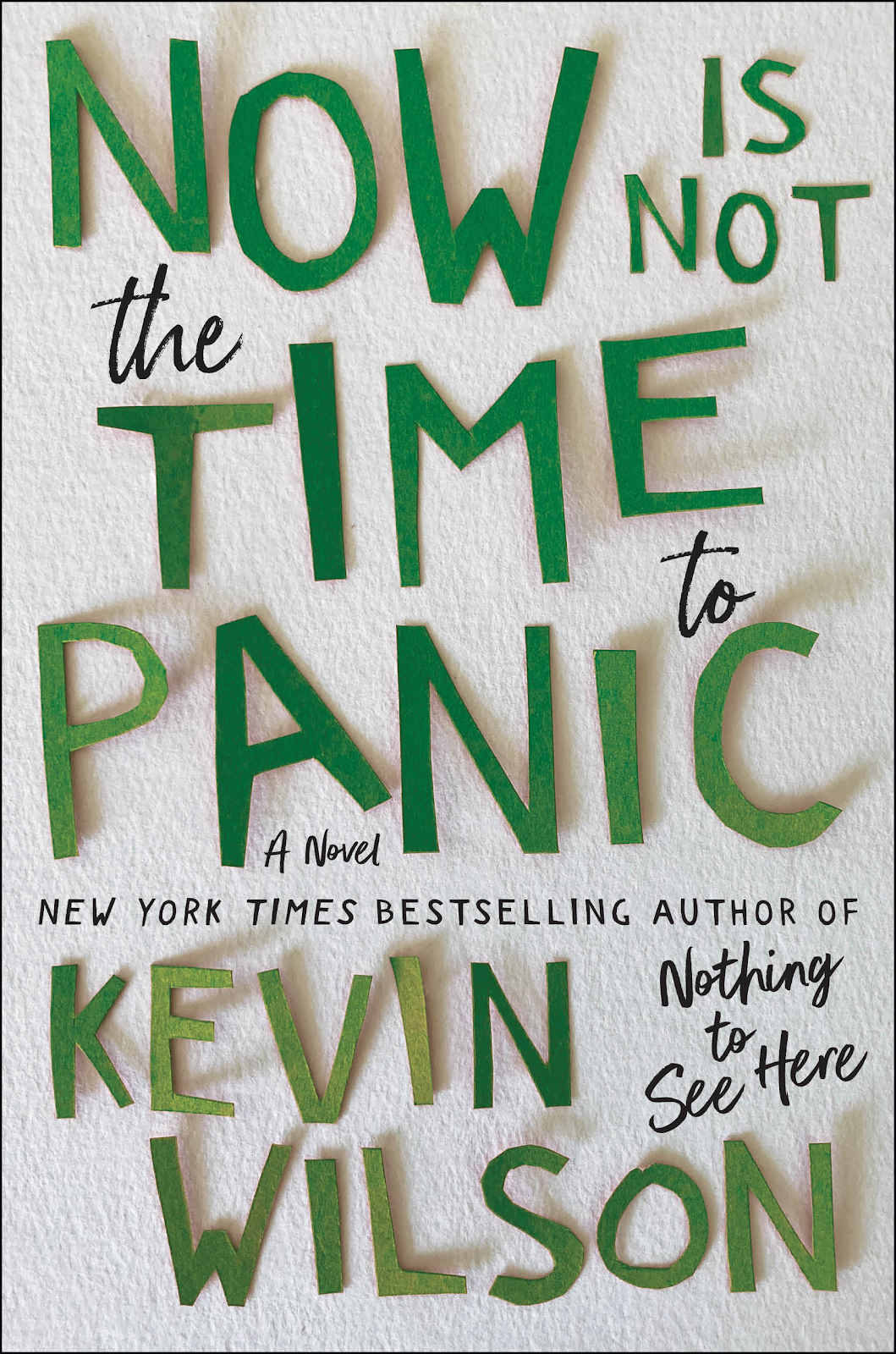
I got the ARC of Kevin Wilson's new novel at the ALA conference in June.  It will be published in November. 

"The edge is a shantytown, filled with gold seekers.  We are fugitives, and the law is skinny with hunger for us."

In the summer of 1996 posters with this mysterious message were plastered all over Coalfield, Kentucky.  What did it mean? Who was behind it and what was their intent?  Everyone had a theory.  National news outlets took notice.   There were sermons, t-shirts, shootings, fires, and an accidental death.  It went as viral as something could in the days before the ubiquity of the internet.

In 2017 Frankie Budge recalls that summer when she was 16. She and her new friend Zeke came up with an antidote for their boredom.   Zeke drew a picture of houses and  a pair of giant hands. Frankie wrote the first words that pop into mind:  "The edge is a shantytown . . ."  And the rest became history. 

Are our long-held secrets truly secrets?  How does the passage of years change the importance of events in our lives?   Kevin Wilson's coming-of-age story is memorable.


Sunday, July 10, 2022

BOTW: two ghost stories

My weekly book reviews are now a separate series of posts.  Look for the label Books of the Week (BOTW) to see them all.   

Jane Yolen spoke at the Literary Tastes breakfast at the ALA Annual Conference.  Her new volume of poetry is Kaddish: Before the Holocaust and After.  She explained that the poems are a new iteration of her family story. She grew up as a cultural Jew, not strongly religious, but the knowledge of the relatives who died in the Holocaust and those who survived it was always-present.  She said that that experience was the basis of her juvenile novel The Devil's Arithmetic.   I promptly put the book on hold and it was ready for me to pick up at the library when I got home. 


Hannah is tired of hearing family stories told and told again. She slips out of the room after the Seder meal and finds herself transported back to a Polish shtetl in 1939.  Introduced as "the cousin from Lublin," she realizes that these are her relatives -- and she knows what is going to happen to Polish Jews.  It's a ghost story with tragedy and triumph, and Hannah returns to the present with a new appreciation for her family.


Jane Yolen signing a copy of Kaddish for me. 


# # # # #


Debut novelist Ramona Emerson was one of the speakers at the Gala Author Tea at the 2022 ALA Annual Conference. Her publisher, Soho, consistently comes out with good mysteries.

Since she was a child Rita Todacheene has been visited by ghosts. Sometimes they comforted her and sometimes they upset her to the concern of her Navajo grandmother. Even the reservation healer could not make the ghosts stay away. Years later Rita is a police forensic photographer who takes pictures at accident and crime scenes. The ghosts of the crime victims come to her and point out evidence that often turns out to be key to investigations. Finally a grisly car crash and a related multiple slaying bring a ghost who will not stop until Rita finds all the evidence for a crooked cop and a massive drug ring.

I'm not a big fan of paranormal fiction but I admired Rita's tenacity and cheered for her success.

Monday, July 4, 2022

Books of the Week: a new feature

For some time I've wanted to separate the book recommendations in each Weekly Update post from the quilting news.  I've had trouble coming up with a good name for a book post. I've settled on Books of the Week (BOTW) and hope that will stick.


In 1918 Dorothea Lange left her home in New Jersey to discover the world. She got as far as San Francisco.  California became her home base where she honed her skill as a photographer. When her portraiture business collapsed in the Depression she became a documentary photographer for the Farm Security Administration.  From migrant workers and farmers in the 1930's to Japanese internment camps in the 1940's, her work is among the most recognizable of the 20th century.   Lange's life story is the subject of nonfiction biographies and an American Masters film.  Elise Hopper's novel stays true to the facts with a deft reimagining -- first person narration, looking back from 1964.     

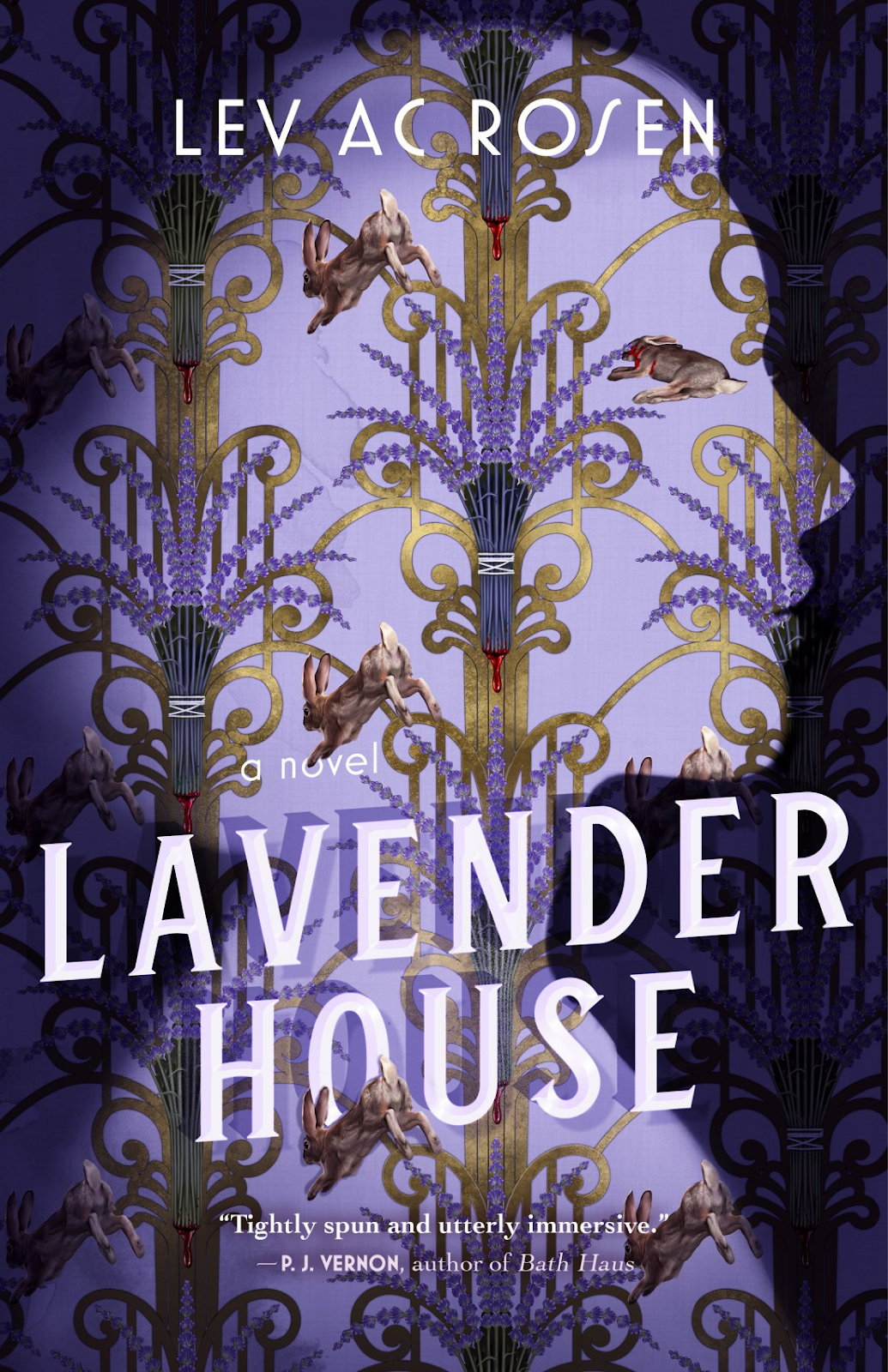
Lev Rosen was a featured author at the Immersive Historical Fiction session at the 2022 ALA Annual Conference. I read the ARC on the flight home. 
Immersive indeed! San Francisco, 1952: Evander "Andy" Mills is yanked out of the closet in a raid (actually, the men's room at a bar) and loses his job/career as a cop because homosexuality is illegal. He isn't unemployed for long, however. Irene Lamontaine, founder of the famous Lamontaine soap factory was found dead in her mansion. Her partner/wife Pearl Valdiez suspects foul play. Andy is pulled into a web of intrigue in the very unconventional household. A little Agatha Christie, a lot of noir, and insights into the challenge/danger of being gay in the 1950's.


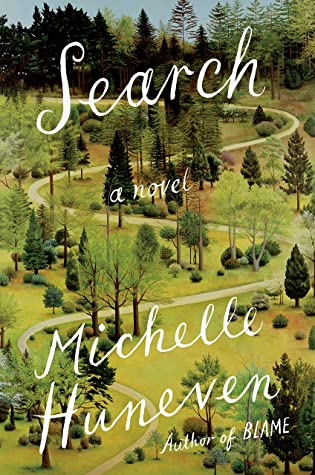
If you've been actively involved in a mainline Protestant Church you'll recognize and appreciate every page of Michelle Huneven's novel about the fictional Arroyo Unitarian Universalist Community Church and the search for its next senior minister.  
Food writer and once-seminarian Dana Potrowski is a reluctant member of the search committee. She becomes the secretary and her documentation becomes a novel that becomes this novel.
 She describes a
ll the stages of group dynamics:  forming, storming, norming and eventually performing.  
Diversity? Check: long-time members; young mom who grew up in this church; young dad new to the denomination; member of the wealthiest benefactors; congregational leaders; IT geek and bell choir director; and the narrator ( mid-50's white hetero woman,  , food writer). Denomination guidelines, consultants, retreats, profiles. The initial candidate pool. Refining the candidate pool. Agreements and disagreements. And, finally: offer made, congregational vote, and (not without controvery): a selection. ........ And did I mention the recipes?  (I will add The Pledge Drive's Fiesta Chicken to my repertoire.) 


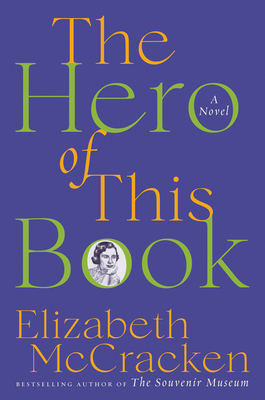
The book cover states that this is a novel. The author writes that this is not a memoir. But this contradiction is the best way to pay tribute to a woman whose own life had many contradictions. The unnamed narrator and her unnamed mother are Elizabeth McCracken and Natalie Jacobson McCracken. (I looked up Natalie's obituary and the details are there.) Physical limitations and personal eccentricities exacerbated by age contradict (again) a brilliant mind and a successful career (see that obituary https://www.bu.edu/articles/2019/the-...). McCracken also remembers her equally brilliant and idiosyncratic father Samuel.(https://www.bu.edu/bostonia/winter-sp...)

I can see how Natalie and Samuel inspired Bertha Truitt and Leviticus Sprague, the stars of McCracken's wonderful novel Bowlaway. We can only hope that our lives will be so richly remembered.