Monday, September 14, 2015

P.E.I. and Nova Scotia: part four

Our second Road Scholar group gathered on Sunday evening, August 30, at the Quality Inn in Summerside, P/E.I.  I told myself firmly to put my Grand Manan memories on a shelf so I could fully appreciate the week ahead. 
"Coastal Communities of P.E.I., Nova Scotia, and Cape Breton" is one of the programs coordinated by  Northshore Institute (Cindy and Peter Blanding). They have worked with Elderhostel/Road Scholar for more than 25 years. Our group leader was Susan Dalziel, a retired teacher who grew up on P.E.I., now in her 8th year as a group leader. She was very deft in keeping the 22 in our group on track. She provided excellent background information to the places we visited (and about the sights we saw as we traveled between those places).   Another important person on the tour was Dale Johnstone, the bus driver, who maneuvered the big coach into parking lots and down country roads. 
P.E.I. is roughly the size of Delaware so it doesn't take long to get from one end of the province to another. Summerside was our 'headquarters' for three nights. 
 No trip to P.E.I. would be complete without seeing Green Gables, the farmhouse immortalized by Lucy Maud Montgomery in the Anne of Green Gables books. It is a national historic site visited by 175,000 people a year, including thousands of Japanese. (Here is the reason why.)   The farm was owned by LMM's aunt and uncle. She visited but didn't live there.


Lucy Mongomery's typewriter

 We spent a day in Charlottetown, the provincial capital.  We sat on the steps of Province House (closed for renovation) as historian Boyde Beck provided a precis of the Charlottetown Conference of 1864. That conference resulted in the Dominion of Canada, federating the provinces. We toured Beaconsfield, built in 1877.for a local merchant and his family. It was later a residence for nursing students. Most of the features remained intact, a boon to historic preservationists.  (I was taken by the tile floors!) 


P.E.I. is the garden spot of Canada -- dairy, potatoes, and other crops.  We visited an organic farm.
. 

The Joggins Fossil Cliffs are a UNESCO World Heritage Site.  Taking souvenirs is strictly prohibited!   The car keys on this plant fossil provide an idea of the size.  We timed our visit a low tide. (Fundy's high tides cover the area where we walked.) 

 On Wednesday morning we loaded our suitcases onto the bus and headed for Nova Scotia and Cape Breton via the Confederation Bridge.  (Cape Breton is connected to Nova Scotia by a mile-long causeway.) Nova Scotia is primarily Scottish, settled by emigrants after the 1744 rebellion. Cape Breton is primarily Acadian, settled by the French, with later Scottish settlement.  Gaelic culture is alive and well! We visited the Gaelic College where we listened to fiddle music and saw step dancing -- as well as a demonstration of How to Wrap a Kilt (as modeled by one of our group).  [They make kilts to order--6,000 hand stitches, $750-$1200 depending on the weight of the fabric and hip measurement.]


I point to the Hamilton clan badge (my mother's maternal line).


Most of Cape Breton is a national park. The Cabot Trail is the main road along the coast. Gorgeous in the sunshine -- but I'm sure it would be beautiful even on a stormy day. 
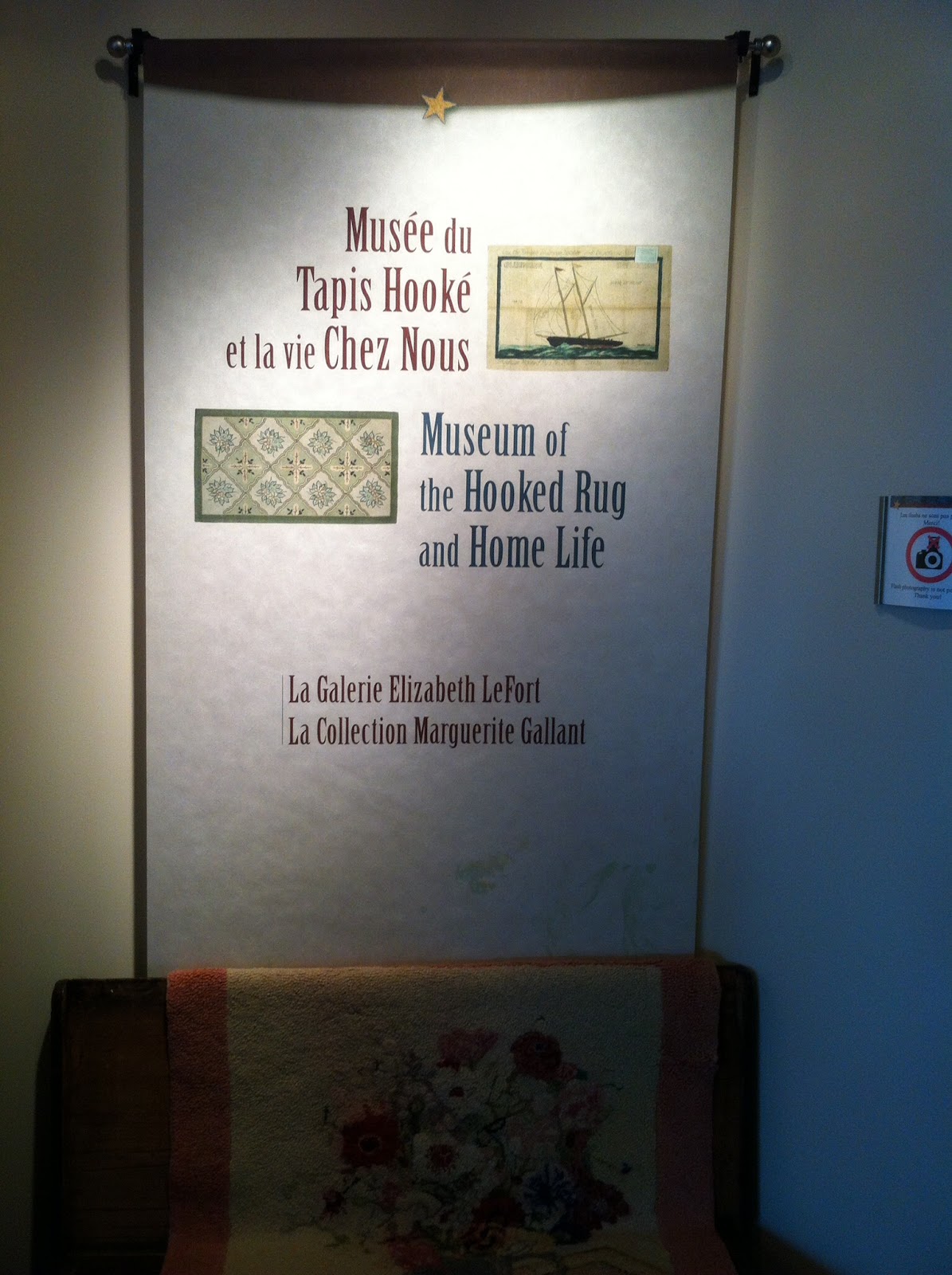


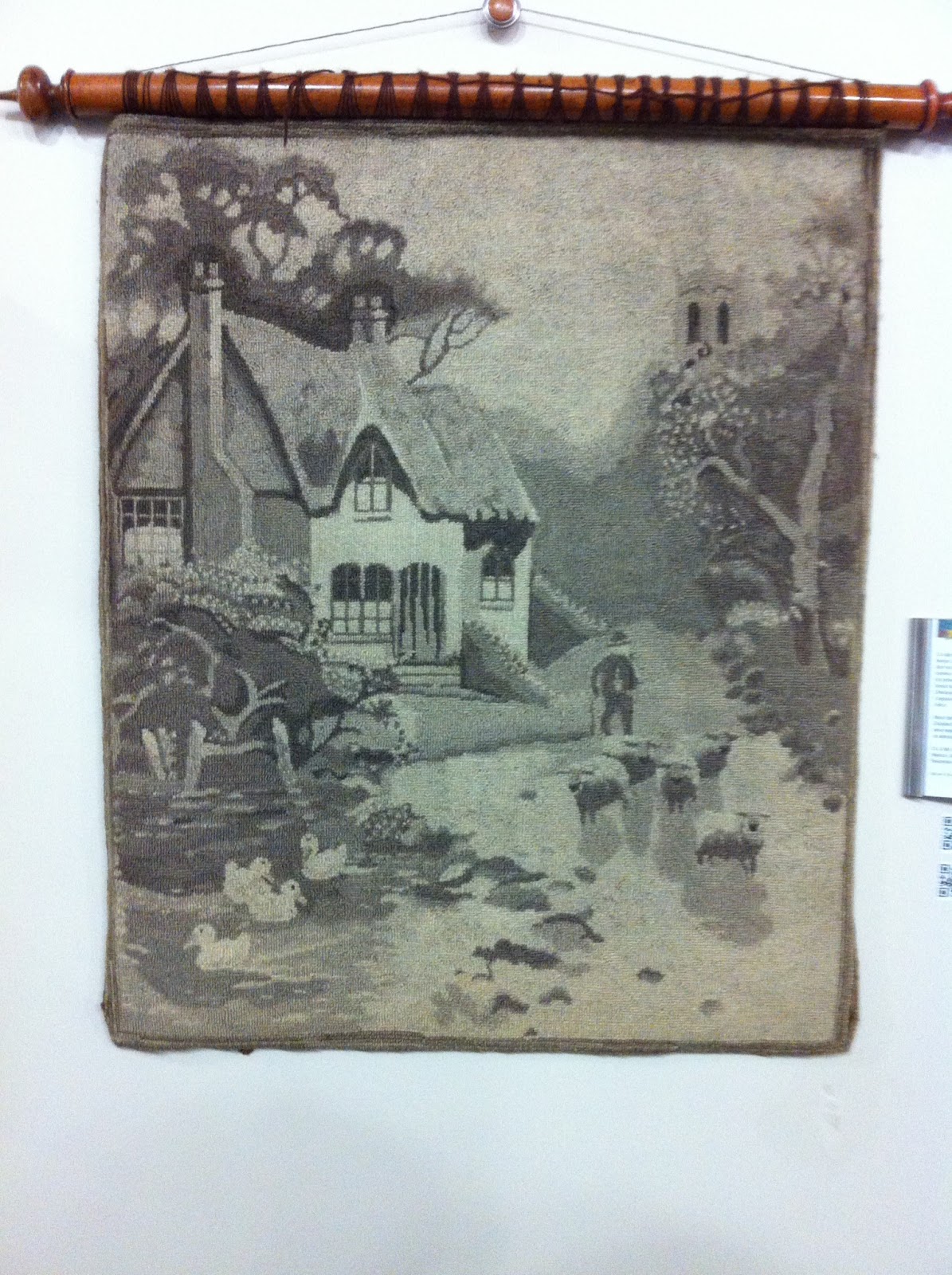
 Hooked rugs are part of the Maritimes' folk art traditions.  We visited the museum in Cheticamp to see the Acadian version, called  "tapis hooke."  [The French word for "hook" is "crochet," but that would be confusing when referring to rug hooking,  hence the borrowed "hooke."] Their technique uses a very short hook, yarn, and burlap. I bought a small kit . . . just to try it out, mind you. :)


Two nights in Baddeck (ba-DECK) at the historic Telegraph House, built in 1861.

Alexander Graham Bell and his family moved to Baddeck in 1885 -- partly as a refuge from humid Washington, DC, and also to escape public demands so he could work on further experiments with electricity and aviation.  The house still belongs to the family so it is not open to the public but the National Heritage Site has a large museum.


I stopped at the Baddeck Public Library.  (Mabel Bell was among its founders.) Note the Gaelic collection!
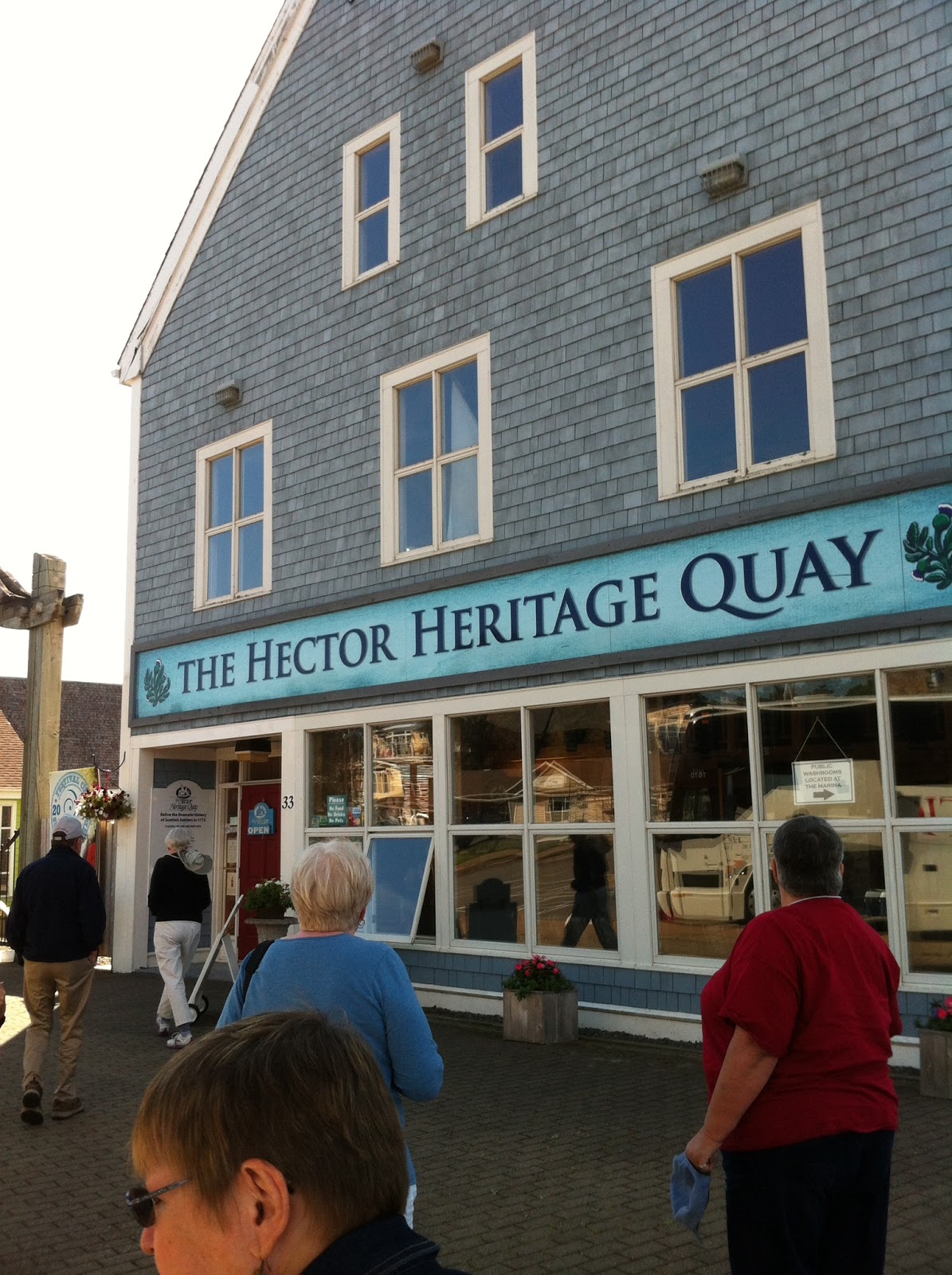


 Saturday morning:  the Hector brought emigrants from Scotland to Nova Scotia i 1773. The ship has been replicated.

Saturday afternoon:  back to P.E.I. and a visit to the beach at PEI National Park.


At our farewell dinner:  a group photo, including our leader Susan (front, left) and driver Dale (far right).


Sunday morning:  we left Summerside at 6:55 Atlantic time. We crossed the border at Houlton, ME at noon, and got to Sturbridge, MA at 7 p.m. Eastern.  We waved to family and friends, former homes and haunts as we sped past.  No time to visit!  Monday: on the road at 7 a.m., across MA and NY --overnight at Westlake, OH (west of Cleveland). Tuesday: on the road at 7 -- pulled into our driveway at noon.   HOME! With many great memories of a wonderful, wonderful trip.


Sunday, September 13, 2015

The weekend: part three

The ferry arrived at Black's Harbour at 11 a.m. on Saturday. We headed north to St. John, the largest city in New Brunswick.  We had lunch at a restaurant on the waterfront. We spent an hour at the New Brunswick Museum which gave us a good overview of the province's history.

(These Hilyards were not our direct relatives, but they got the right spelling!)

We drove south from St. John along the picturesque Fundy Trail, and arrived at our hotel in downtown Moncton late in the afternoon.

Moncton is on the Petitcodiac River which has a tidal bore. As Wikipedia says, that is "a regularly occurring wave that travels up the river on the leading edge of the incoming tide. The bore is  a result of the extreme tides Bay of Fundy."   Our hotel was on the river, adjacent to a viewing site. The bore schedule was posted in the lobby. I went out about 10;15.  I was among a half-dozen other tourists watching. At 10:22, right on schedule, we heard a low roar -- saw a glimmer (lit by the street lights) -- and there it was: a wave the width of the river..  [Too dark for pictures and clouds obscured the moon.] 


Sunday morning we drove south to Hopewell Rocks, aka the Flowerpot Rocks. The sandstone has been worn away by the oceans into fantastic shapes. It's a big tourist attraction.  There is a very good interpretive exhibit at the visitor center. 


 We returned to Moncton to visit Resurgo , the municipal museum. It combines the local history collection with a transportation / industrical heritage museum with great interactive kids' activities.

We said goodbye to New Brunswick (we want to return!) and drove across the Confederation Bridge to Prince Edward Island.  Time for the next Road Scholar adventure!   Read on for part four . . .
image from Wikipedia 


Grand Manan: vacation, part two

Photo: Tourism New Brunswick 


 Marathon Inn is a hop, skip, and jump from the Grand Manan ferry dock. We checked in early Sunday afternoon.  The Road Scholar group would not convene until suppertime. We used the free time to explore some of the island.  Here is our 35th wedding anniversary photo, snapped at South West Head. 


At last it was time for Road Scholar to begin!   There were 19 people in the group. We came from
Arizona, Oregon, Montana, Florida, New York, New Jersey, Kentucky, Michigan, Virginia, and Illinois (us). Ages ranged from 60 to 90.  We had a variety of professions including teachers, a nurse, an engineer, two pastors, two librarians, a medical illustrator (now watercolorist).  One is a P.E.O.! Several were avid birders (the course advertised "a whaling and birding paradise").

Jim Leslie has owned the Marathon Inn since 1977 and has led Road Scholar programs since 1991.  He is the group leader, on site coordinator, bus driver, and cook. (He's also the head of maintenance, an important job in a 125-year-old resort hotel.)  He was among the best group leaders we've had -- attentive to individuals without being intrusive. And his storytelling led us to compare him to Garrision Keillor.

Our activities covered the island:
* Whale watching -- a beautiful day to be on the Bay of Fundy, but unfortunately for us the whales took the day off.  We saw some harbor porpoises (a species of toothed whale) but that was all.
I hold a stormy petrel chick
* Birding -- guide Roger Burrows has written regional birding books. He took us to White Head, an island off Grand Manan.
* Daily life on the island:  Grand Manan is an "industrial" island with active fisheries -- lobster, scallops, and salmon. The salmon are farmed and we got up close to the "tanks" where they are kept.
* Island history:  the Grand Manan Museum has comprehensive exhibits (geology, early settlement, shipwrecks, and more) -- we had one rainy morning, perfect for visiting the museum.

 Stevens "indulsed" at the dulse shop. (Dulse is seaweed gathered, dried, and packaged locally.)


Stevens and I attended the GM Rotary Club's breakfast meeting on Thursday. (I left my windbreaker behind. When we got back to the Marathon I told Jim I'd need to go back to get it. He said, "Do recall who was there?" I said, "The only name I remember is Robbie." Jim said to the front desk hostess:  "Call Robbie Griffin's wife and ask for his cell phone number. Then call him to say that our guest will be going back to the church hall to get her jacket."  The hostess did just that, and Robbie was at the church hall.  Jim knows everyone on GM!)


DJD's cottage 

Willa Cather's cottage
I knew that Willa Cather had summered on Grand Manan in the early 1900's. I mentioned that in an email to a librarian friend. She said I should try to meet DJD, a former librarian whose summer home is one of the "cottages" from Cather's era.  I was able to get a message to DJD, who reached me at the Marathon and invited us to visit.  The cottage was built by her aunts who bequeathed it to her. She's been coming to GM since the 1940's.   She warned us that Cather's cottage is a summer rental, strictly off-limits to tourists. She drove us to the edge of the property and I got a picture! (See this post for a review of a mystery featuring Cather on GM.)


Say Polar Bear!
On Friday we went to Kent Island, just southeast of GM. It is owned by Bowdoin College and operates as a research station .  Bowdoin holds a freshman orientation session there and we met a group from the class of 2019 on the dock.

And then it was Saturday: time to pack our bags and head for the next part of our adventure.

On to part three . . .

Modern lobster traps

Vintage lobster buoys

Rocks....just because.  


To the Maritimes and back: vacation report

Three weeks. 3,891 miles. Five provinces. Ten states.  Historic sites (man-made and nature-made).  Three ferries and a very long bridge.  Dozens of birds, no whales, a group of (Bowdoin) Polar Bears.   Forty-eight new acquaintances. Two memorable Road Scholar programs.  It all added up to a memorable vacation!

Here are the official descriptions of the two Road Scholar programs. Grand Manan: A Whale and Birding Paradise and Coastal Communities of Prince Edward Island, Nova Scotia, and Cape Breton
Of the 32 RS trips we'e taken, seven have been in Canada (previously: Vancouver, Newfoundland, the Magdalens (two back-to-back: see here), Quebec (here).

We wanted flexibility in pre- and post-Road Scholar travel. We could have flown and rented a car, but we'd have had to get to and from airports, and the car was parked most of the second week (the group toured by bus).  Though the physical drive was tiring (I did most of it), we were glad to have our own vehicle.

Wednesday, August 19:  We crossed the border at Port Huron/Sarnia.  Canada customs was a breeze.  First night: Tillsonburg, Ontario.  We stayed at a remodeled inn (originally a mill built in 1878). It had one of the town's three barn quilt blocks.

Thursday, August 20: We took the freeway around Toronto. At Kingston we turned south and drove along the St. Lawrence River.  We want to go back to explore more of the Thousand Islands country.   That night: Cornwall, Ontario.


Just over the border
Friday, August 21:  A day of ups and downs. I exited too soon at Sherbrooke and took the long way thought the city instead of the bypass. (In the rain.) Got on the right road but headed in the wrong direction. Had lunch in a pleasant cafe in the hamlet of Sawyerville. (In the rain.)

Turned the right way, got to the border. (No rain.) I took a picture of the Coburn Gore border crossing. The border patrol guy said to delete it, photos are forbidden. So I did. Then a long roughly diagonal trip through the woods to route 95 and north to Bangor. (In the rain.) Like so many people coming from Canada, we had to go to the Bangor Mall (The sole of one of Stevens' good sneakers pulled off. He got sole glue and a new pair (on sale) at Dick's Sporting Goods.)  


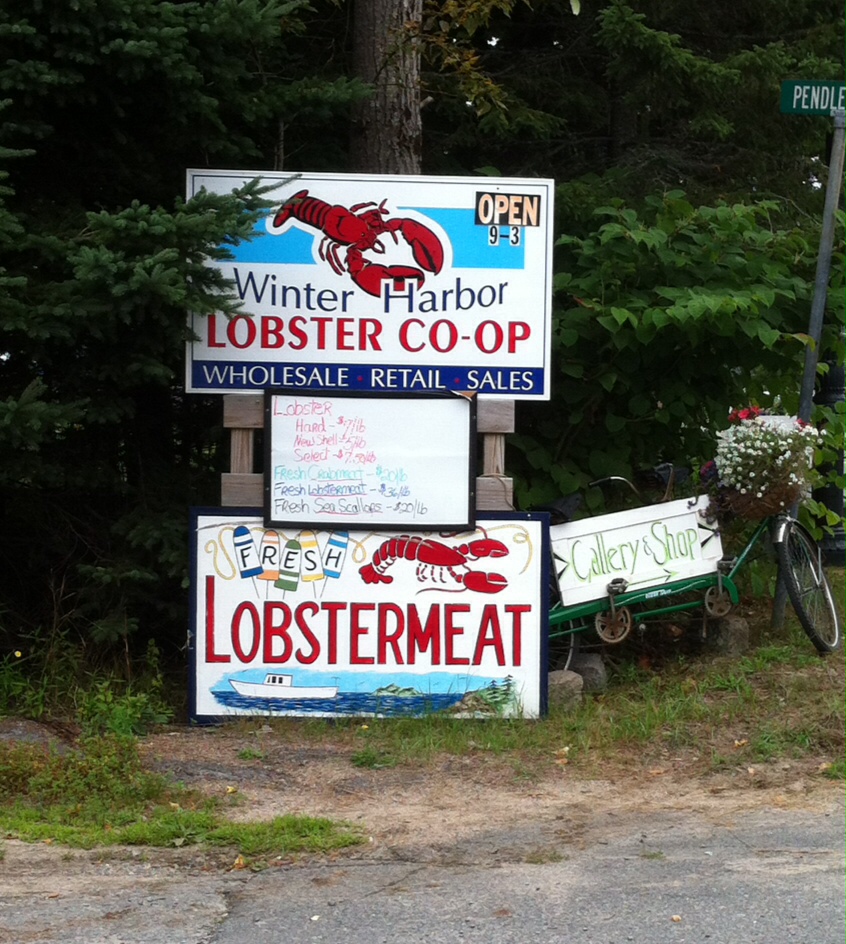
Saturday, August 22:  We headed east from Bangor to the coast and headed north on Route 1.  We had "chowdah for lunch at th' dinah" -- overhearing a table with local guys talkin' just like that.  When I first moved to Winthrop Harbor Stevens kept calling it Winter Harbor.  We drove through the real Winter Harbor and stopped so I could go inside the library. (The building was originally Channing Chapel, a Unitarian church.)  

 We crossed the border from Maine to New Brunswick at Calais about 4 p.m. Eastern/ 5 p.m. Atlantic. We spent the night in the little town of St. George.  


Boxes for blueberry pickers


Sunday, August 23:  We explored a few side roads on the way from St. George to Black's Harbour. Lots of wild blueberries!

We were the second in line for the 11:30 ferry from Black's Harbour to Grand Manan. In an hour we were on the island.

On to part two . . .


Friday, September 11, 2015

ALA Candidacy


Nann Blaine Hilyard
Candidate for SECRETARY, Retired Members Round Table 


Statement of Professional Concerns/Aspirations if Elected:
In thirty years of ALA involvement I have found great satisfaction not only in committee and division work but also in the many friendships I have made with colleagues.  RMRT provides long-time librarians continuing fellowship and the opportunity to contribute to the work of ALA and the library profession.  I look forward to helping to develop RMRT's programs and services as we welcome new retirees to our group.
I have held the office of secretary in several organizations and I am an experienced minutes-taker. 


Current Position:
Retired, Winthrop Harbor, Illinois

Previous Position:
Director, Zion-Benton Public Library, 2003-2014
Director, Lake Villa District Library, 1998-2002
Director, Fargo Public Library, 1994-1998

Degrees and Certificates:
University of Missouri, AM - Library Science, 1974; University of Missouri, AB-Library Science, 1973.

Division Affiliation: 
UNITED and RUSA

To which Round Tables do you belong? 
Intellectual Freedom Round Table (IFRT) and Retired Members Round Table (RMRT)

ALA and/or ALA-APA Activities:
ALA: Maine Chapter Councilor, 87-90; Councilor-at-Large, 98-04 and 11-13; Exec Bd 04-07.
Committees: Chp Relations, 91-94; Library Advocacy Now, 92-96; Resolutions 01-03; COO 01; Public Programs 09-11.
PLA: Sm & Med Libraries Sec Pres 97-98, Lib Dev Cluster 99-02 and Chm 01-02; Rep to ALTAFF 07-09; Leg Comm 93-95; Univ Press Books 90-94, 08-10, chm 11-13; Public Libraries Advisory, 03-05; IFC 99-02; Columnist 98-12.
United:  PLA Program Committee, 15; Liaison to FTRF 14-16; Legislation 15-16.
RUSA: Univ Press Books Chm 13-14, member 15-16
ALA Biblioquilters (unofficial):  convenor, 1998-present.

Offices held in state/regional library associations, and other associations: 
Maine LA: Treasurer, 1984-87, VP 1988-90, Pres 1990-92; Maine Lib Commission, 1984-94, Chair 1991-93.
North Dakota LA: Pub Lib Sec pres, 1996-97.
Illinois LA: PL Forum chair, 99-00; Intellectual Freedom, 03-05; Membership 08-09.
White House Conf. Taskforce: Transition Team, 91-92; Vice Chm, 92-96; Newsletter ed. 96-00.
Reaching Across Illinois Library System: board member, 13- 16.  
AAUW, 1975-present: branch president (ME, ND, IL); state president (ND); state finance, newsletter, vice president (IL), Association public policy cmte (97-01)
P.E.O. Sisterhood, 1985-present; local chapter offices and state committee chair (13-16).
Northern Lake Co Quilters Guild: president, 12-16.
Coalition for Healthy Communities: 03-08; secretary 08-15.
Chamber of Commerce: 11-15; secretary 14-15.
Rotary: 2003-present; club president 07-08; bulletin editor, 08-present

Honors and Awards:
White House Conf. Taskforce Achievement Award, 1996.

Major Accomplishments:
* Co-founded ALA Biblioquilters in 1998. The group collaborates to make quilts for the silent auction at ALA Annual Conference. Since 2000 more than $10,000 has been raised for the ERT Hoy Scholarship Fund.
* Active book reviewer, giving presentations to community groups each year.
* Audiobook reviewer since 1988. Audies competition judge since 2000.

Publication:
Contributing columnist, "Perspectives," Public Libraries: PLA Journal, 1998-2012.
Contributing columnist, Zion-Benton News, 2011-present.